
Flat Roof Lifespan Guide for UK Property Owners
A flat roof can look sound from ground level while water is slowly finding its way through failed laps, cracked detailing or blocked outlets. This flat roof lifespan guide explains what property owners, buyers and landlords should realistically expect from common roof coverings, what shortens their service life, and when an inspection is worth arranging before a small defect becomes an internal repair claim.
Flat roofs are not inherently short-lived. Their performance depends on the roof system, installation quality, drainage design, exposure and maintenance. A well-specified roof covering installed over a sound deck can serve a property for decades. Poor falls, standing water or neglected outlets can reduce that period significantly.
How long does a flat roof last?
There is no single answer because “flat roof” describes a roof shape rather than one material. As a broad UK guide, felt roofs often last around 10 to 20 years, EPDM rubber commonly 20 to 30 years, GRP fibreglass typically 20 to 30 years, and high-quality single-ply or liquid-applied systems may last 25 years or longer where correctly designed and maintained.
These are expected ranges, not guarantees. A roof can fail early if it was laid over wet or deteriorated timber, if junctions were poorly formed, or if rainwater cannot escape effectively. Equally, an older roof may remain serviceable beyond its anticipated life where defects have been identified and repaired promptly.
The construction beneath the covering matters just as much. In a cold roof, insulation sits below the deck and ventilation must control condensation risk. In a warm roof, insulation sits above the deck, generally reducing condensation risk but requiring sound detailing at perimeters, outlets and upstands. A survey should consider the whole assembly, not simply the visible surface.
Typical lifespan by roof covering
Built-up felt roofing remains common on garages, extensions and low-rise blocks. Modern torch-on felt systems can perform well, but seams, flashings and exposed edges need close attention as they age. Blistering, splitting and mineral loss are signs that repairs or renewal may be approaching.
EPDM is a flexible rubber membrane with relatively few joints. It is resistant to weathering, but it can still suffer punctures, lifted edges, adhesive failure and deterioration around rooflights or drainage points. Its apparent simplicity does not remove the need for proper preparation and compatible materials.
GRP fibreglass forms a hard, seamless finish and is widely used on domestic extensions. It can offer a long service life, although movement in the deck, weak trims or poor installation conditions may lead to cracking. Local repairs are possible, but widespread cracking deserves a closer assessment rather than repeated patching.
Single-ply membranes are often used on larger commercial or multi-unit roofs. Their lifespan depends heavily on specification, joint welding and protection from foot traffic. Liquid-applied systems can be particularly useful on complex roofs with many penetrations, provided the substrate is suitable and surface preparation is thorough.
What reduces a flat roof’s lifespan?
Water should drain from a flat roof, despite the name. Most roofs are designed with slight falls towards gutters, outlets or internal drains. Ponding water that remains for more than 48 hours after rainfall can accelerate deterioration, add loading and highlight a drainage or settlement issue. It is not always an immediate failure, but it should not be ignored.
Blocked outlets are one of the most preventable causes of damage. Leaves, moss, silt and loose chippings can restrict drainage, causing water to build up at vulnerable details. Overflowing gutters may also send water down external walls, creating staining, dampness and damage that can be mistaken for a separate defect.
Sunlight and temperature movement gradually affect all roof coverings. UV exposure can embrittle older felt, while repeated expansion and contraction places stress on laps, trims and junctions. Roofs with frequent foot traffic, air-conditioning equipment or poorly supported solar installations face an added risk of punctures and localised wear.
Installation defects often remain hidden until the first sustained period of rain. Common concerns include inadequate upstand heights, poorly bonded laps, unsupported membrane edges, unsuitable falls and poorly sealed penetrations around pipes or cables. A new-looking roof is not necessarily a reliable roof, particularly where there is no clear record of the system installed or the work completed.
Warning signs that need professional attention
A ceiling stain beneath a flat roof is a late symptom, not the start of the problem. Moisture may travel through insulation, along joists or across the underside of a deck before becoming visible indoors. By that stage, insulation performance may have reduced and concealed timber decay may be developing.
From accessible areas, look for standing water, open seams, splits, blisters, exposed reinforcement, cracked GRP, lifted flashings and damaged edge trims. Inside, watch for damp patches, peeling finishes, mould, a musty smell or sagging plasterboard. These signs do not automatically mean full replacement is required, but they justify investigation.
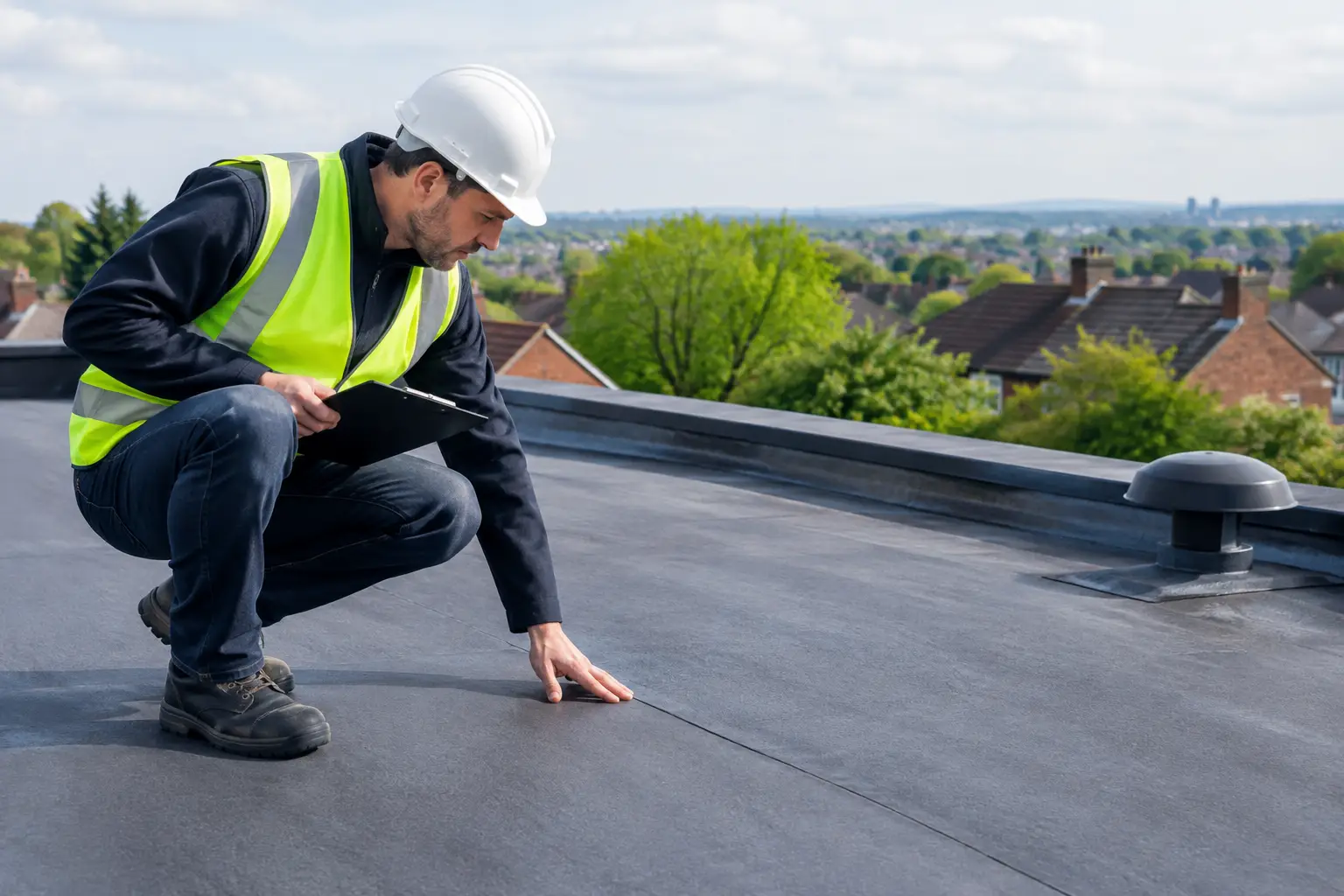
Do not walk on a roof unless it has been designed for safe access and you can do so without damaging the covering. Older roofs can have weak decking, concealed defects or slippery surfaces. A close-up roof inspection is safer and more useful when completed by an experienced surveyor who can assess the covering, drainage, junctions and supporting construction together.
Repair or replacement: which is better value?
Localised damage on a relatively young roof can often be repaired economically. For example, a small puncture in an otherwise sound membrane, a failed outlet detail or a limited area of split felt may not justify complete renewal. The key question is whether the defect is isolated or evidence of wider material failure.
Replacement becomes more sensible where there are repeated leaks, widespread cracking, extensive ponding, deteriorated insulation, a failing deck or several layers of previous patch repairs. Overlaying a roof can sometimes reduce initial cost, but it may conceal wet materials or structural defects beneath. Removing the existing covering provides a clearer view of the substrate, although it will usually involve greater cost and disruption.
For a buyer, the decision is also about timing and negotiation. An ageing flat roof with no active leak may still be a foreseeable expense. A detailed report that identifies condition, likely causes and the urgency of remedial work can support a realistic budget before exchange, rather than an unexpected bill after completion.
Flat roof lifespan guide: maintenance that protects value
Inspection frequency should reflect the roof’s age, condition, use and exposure. As a practical baseline, inspect accessible flat roofs at least twice a year, ideally after autumn leaf fall and after winter weather, as well as following severe storms. Landlords and managing agents should also consider their wider repair obligations and keep clear maintenance records.
A sensible maintenance visit focuses on drainage, surface condition and vulnerable details. Clear leaves and debris from gutters and outlets, check that flashings and edge trims remain secure, and look for damage around rooflights, vents and service penetrations. Avoid applying sealants as a universal cure. Incompatible products or poorly prepared repairs can trap water and make future diagnosis harder.
Keep photographs, invoices, installation certificates and any guarantee documentation. These records can help a surveyor understand the roof’s history, assist with warranty discussions and provide useful evidence when selling a property. They also make it easier to distinguish a recurring defect from a one-off incident.
When to arrange a roof survey
A dedicated roof survey is particularly valuable before buying a property with a flat-roof extension, balcony, garage or top-floor accommodation. It is also appropriate where there is persistent dampness, unexplained staining, visible roof deterioration, a dispute over recent works or concern about the likely cost of renewal.
A professional inspection should explain the construction where it can be identified, record visible defects, assess their probable significance and set out proportionate next steps. In some cases, moisture testing or thermographic investigation may help establish whether water has affected insulation or concealed areas. No non-invasive inspection can see every hidden defect, but clear limitations and targeted recommendations allow informed decisions.
HICH LTD provides practical building and roof inspections for clients who need clear evidence of condition, defect severity and likely repair priorities. For property owners, the value is not simply finding a leak. It is understanding whether the roof needs routine maintenance, a defined repair or a planned replacement budget.
A flat roof rarely fails without warning. Acting when drainage slows, materials begin to crack or internal finishes first change can protect the building fabric and give you more control over the cost and timing of repairs.