

Example: A Structural Survey Found Subsidence
The buyer had already agreed a price for a 1930s semi-detached house when a crack beside the rear extension door changed the conversation. It was not simply a cosmetic line in old plaster. In this structural survey found subsidence example, the crack pattern, distorted opening and external ground conditions pointed to movement that required proper investigation before exchange of contracts.
A structural survey is not designed to create alarm from every crack. Older homes move for many reasons, and some movement is historic or seasonal. Its value lies in separating ordinary age-related defects from signs that a foundation, soil, drainage or nearby vegetation issue may be affecting the building – then setting out the evidence, risk and sensible next steps.
The property and the initial concern
The property was a two-storey brick-built semi with a single-storey rear extension, believed to have been added in the 1980s. The buyer had noticed a diagonal crack internally running from the corner of the patio door towards the ceiling. The seller described it as a previous repair, but the crack had reopened and the door was catching on its frame.
A standard viewing cannot establish whether this is settlement, thermal movement, poor workmanship or subsidence. The concern justified a targeted structural inspection because the defect affected an opening, had a diagonal profile and appeared to correspond with cracking to the external brickwork.
What the structural survey found: subsidence example
The inspection identified movement concentrated at the rear corner of the extension rather than across the original house. This distinction mattered. A localised defect may have a more contained cause and repair scope, although it must still be investigated carefully.
Evidence recorded during the inspection
The surveyor documented the position, direction and width of cracks, checked for distortion around doors and windows, and compared the extension with the main building. The following observations formed the basis of the assessment:
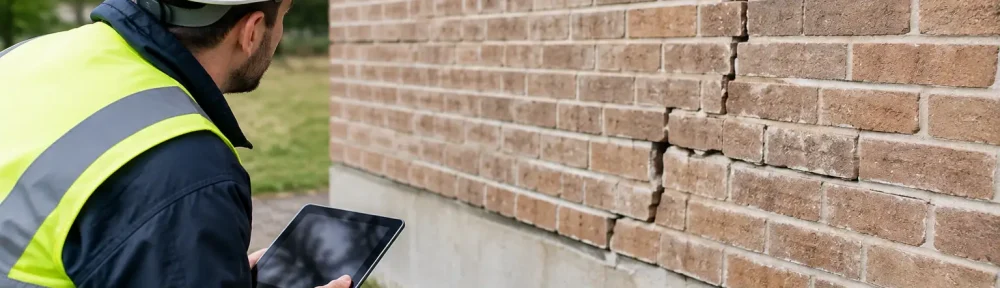
- A stepped crack of approximately 4mm to 6mm ran through the external brickwork close to the rear extension corner.
- An internal diagonal crack had reopened after previous filling, with minor separation at the skirting board.
- The patio door frame was out of square and the door caught at the upper corner.
- A mature willow tree stood within influencing distance of the extension.
- The extension downpipe discharged close to the affected corner, where the ground showed signs of poor falls and local saturation.
No single observation proves subsidence. Together, however, they indicated differential movement – one part of the structure moving more than another. The pattern was consistent with possible shrinkable clay soils being influenced by moisture change, potentially worsened by the nearby tree and defective surface-water management.
The report did not state that underpinning was immediately required. That would have been premature without confirming the ground conditions, drainage performance and whether movement was ongoing. Instead, it graded the matter as requiring further investigation before purchase and provided a clear route to reach a defensible decision.
Why the cause cannot be assumed from cracks alone
Subsidence is downward movement of the ground supporting a building. In UK housing, it is often associated with clay shrinkage, trees, leaking drains, poor foundations, mining legacy or ground washout. Yet cracks can also result from normal thermal expansion, an extension built on different foundations, lintel defects, past settlement or alterations that have weakened a wall.
In this example, the extension was more vulnerable than the original house because it was likely built later and on different foundations. The surveyor also found no corresponding serious cracking to the front elevation or first-floor walls. That reduced the likelihood of widespread movement affecting the entire property, but it did not remove the need to understand the rear defect.
The practical point for a buyer is that a survey should explain both the likely cause and the uncertainty. A confident diagnosis unsupported by inspection evidence can lead to unnecessary expense. Equally, accepting a seller’s assurance that a crack is old can leave a buyer responsible for a developing structural issue.
Recommended investigations before commitment
The report advised the buyer to obtain a drainage survey using CCTV, seek confirmation of the soil type and arrange a structural engineer’s review if the findings remained concerning. It also recommended asking the seller for any previous insurance claims, guarantees, building control records and photographs showing when the crack first appeared.
Drainage was a priority because a leaking drain can soften or wash away supporting ground. If the drain proved defective, repair may address a major contributory factor at a comparatively manageable cost. The downpipe arrangement also needed alteration so rainwater was carried to a suitable drainage point rather than discharged beside the foundations.
The mature willow required careful consideration. Tree management can be part of a solution on shrinkable clay, but removing a large tree too quickly can also cause ground rehydration and heave. Any pruning or removal programme should therefore be based on professional advice, not an assumption that cutting down the tree will automatically solve the problem.
Crack monitoring was recommended where there was uncertainty about whether movement remained active. Tell-tales or precise measurements recorded over time can establish whether cracking is stable, seasonal or progressively worsening. This is particularly useful when the property is not showing immediate signs of severe structural instability but the transaction depends on evidence rather than guesswork.
What happened next in this example
The drainage survey found a fractured section of clay pipe close to the extension. The defect was repaired, the rainwater discharge was redirected and the buyer obtained a structural engineer’s opinion. The engineer considered the cracking likely to be the result of a combination of local drainage leakage and clay-related seasonal movement, with the tree as a possible influencing factor.
Because the available evidence did not show significant ongoing movement, underpinning was not recommended at that stage. The buyer negotiated a price reduction to reflect the drainage works already completed, future monitoring, redecorative repairs and the risk of managing the tree. The seller also provided a record of the remedial work for the buyer’s insurer.
This is not the outcome in every case. Active movement, substantial crack widths, failing foundations or a history of subsidence claims can affect mortgage lending, insurance terms and resale prospects. Some properties require major structural work; others need drainage repair, monitoring and targeted crack repairs. The cost and urgency depend on the cause, extent, location and whether the movement is continuing.
What buyers and homeowners should do when subsidence is suspected
Act early, but do not jump to the most expensive remedy. Photograph cracking with a scale, note dates and changes, and look for practical clues such as sticking doors, gaps around frames, uneven floors or damaged external drains. Avoid filling and repainting significant cracks before they have been assessed, as this can obscure evidence of movement.
For a purchase, make further investigation a condition of your decision rather than relying on a verbal explanation. A detailed structural survey gives you a written record of defects, likely causes, recommended specialists and the implications for repair planning. It can also provide the evidence needed to renegotiate, request repairs or decide that the risk is not right for you.
For an occupied property, address obvious water-management issues promptly and notify your insurer where a potential subsidence claim may be relevant. Do not commission foundation work until the cause has been properly evaluated. The correct remedy is often less disruptive and less costly than the one property owners fear most.
A qualified inspection from a specialist such as HICH LTD can turn an unsettling crack into a clear plan of action. The aim is not to make a property decision for you, but to give you the practical evidence to make it with confidence.