

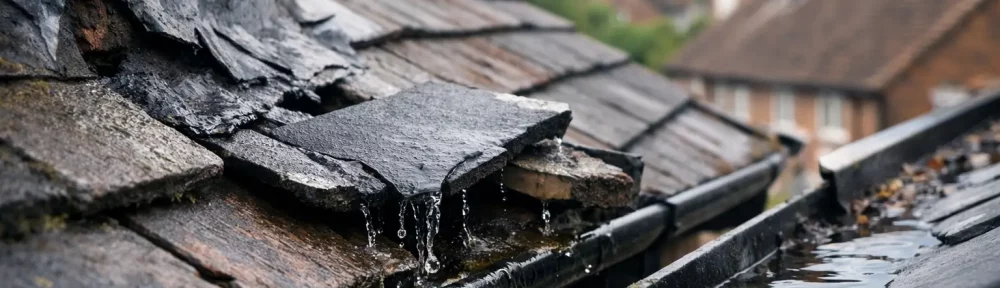
A roof leak rarely begins with water dripping through a ceiling. More often, it starts as a small failure at a joint, tile edge or roof penetration, then becomes visible only after repeated rainfall and wind exposure. Understanding the top causes of roof leaks helps homeowners, buyers and landlords act before a local repair turns into damaged insulation, decayed timber or mould growth.
The visible damp patch is not always directly below the defect. Water can travel along rafters, roof felt, cables and masonry before reaching a ceiling or wall. That is why an informed inspection matters: the aim is to identify the entry point, assess the extent of concealed damage and set out the most proportionate repair.
Top causes of roof leaks and why they develop
Broken, slipped or missing roof tiles and slates
Pitched roofs rely on overlapping tiles or slates to shed water. A single cracked, slipped or missing unit can expose the underlay and battens beneath, especially where wind-driven rain is involved. Storms, frost damage, ageing fixings and foot traffic can all cause individual coverings to fail.
This does not always mean the whole roof needs replacing. If the surrounding coverings, fixings and underlay remain sound, a targeted repair may be appropriate. However, repeated slipped tiles can point to more than poor weather resistance. Corroded nails, deteriorating battens or an unsuitable roof pitch may be contributing to a wider problem.
On older properties, replacement materials need careful consideration. Modern tiles may not match the profile, colour or weight of existing coverings, and an inappropriate repair can affect both appearance and performance.
Defective flashing around chimneys and junctions
Flashing is the weatherproof material installed where the roof meets a chimney, wall, dormer, valley or rooflight. Lead is common on traditional roofs, while modern systems may use proprietary alternatives. These details are among the most vulnerable parts of any roof because they must accommodate changes in temperature, movement and rainwater flow.
Cracked mortar fillets, lifted lead, failed sealant or poorly dressed flashing can allow water behind the roof covering. Chimney abutments are a frequent source of leaks, particularly where pointing has failed or previous repairs have relied on excessive sealant rather than correctly formed leadwork.
A repair should address the detail, not simply cover the symptom. Applying mastic over split flashing may reduce water ingress temporarily, but it can conceal deterioration and make a proper future repair more difficult.
Failed valleys and blocked rainwater routes
A valley is the channel where two roof slopes meet. It receives a concentrated volume of water, making it a high-risk area if tiles are displaced, lead has split or a lining has deteriorated. Open valleys may become blocked by leaves, moss, mortar debris or broken tile fragments, causing water to back up beneath adjacent coverings.
Gutters and downpipes create a related risk. When a gutter is blocked, overflowing water can soak fascia boards, masonry and the lower edge of the roof. It may look like a roof leak from inside the property, particularly where water finds its way into the eaves.
Regular clearing is relatively inexpensive, but it should be carried out safely. If access is difficult, or gutters are repeatedly filling with debris, a professional assessment can establish whether the fall, outlet position or nearby vegetation is creating an ongoing maintenance issue.
Ageing or damaged flat-roof coverings
Flat roofs are often described as flat, but they need a sufficient fall to direct water towards outlets. Ponding water, blistered felt, cracked asphalt, split membranes and failed seams are common causes of leaks in garages, extensions, porches and dormers.
The condition of the roof covering is only part of the assessment. Water can enter at perimeter upstands, rooflight surrounds, outlets and poorly sealed service penetrations. A local split may be repairable, but widespread crazing, repeated patching or persistent ponding may indicate that renewal is better value over the medium term.
The appropriate solution depends on the existing construction. Overlaying an old roof can be cost-effective in some circumstances, but only where trapped moisture, deck condition and drainage have been properly considered. Covering over a failed substrate simply postpones the problem.
Deteriorated underlay, battens and roof timbers
Tiles and slates are the first line of defence, but underlay provides secondary protection against wind-blown rain and dust. On older roofs, bituminous felt can become brittle or tear, while modern membranes may sag if poorly installed. When underlay fails, small defects in the external covering are more likely to produce internal staining.
Persistent moisture also damages timber battens and, in serious cases, roof structure. Signs can include sagging roof lines, widespread tile movement, staining in the loft or soft, decayed timber. These concerns should not be treated as cosmetic. A survey can distinguish a local maintenance defect from an issue affecting structural integrity and repair scope.
Roof penetrations, rooflights and ventilation details
Every penetration through a roof creates a potential weak point. Soil vent pipes, extractor vents, flues, solar-panel fixings and rooflights all require properly formed weathering details. Ageing collars around pipes, cracked rooflight seals and poorly installed flashing can allow water through even when the main roof covering appears sound.
Condensation can also be mistaken for a leak. Bathrooms, kitchens and poorly ventilated lofts produce moisture that can condense on cold surfaces. Unlike rainwater ingress, condensation often presents as widespread dampness, mould or droplets on the underside of the roof covering, particularly during colder months. The remedy may involve ventilation and insulation improvements rather than external roof repair.
Poor previous repairs and unsuitable alterations
A roof can look recently repaired while still performing badly. Common warning signs include mismatched tiles that do not interlock properly, excessive sealant, loose flashing, poorly installed solar equipment and alterations that interrupt drainage paths.
The lowest initial quote is not always the lowest overall cost. Work that fails to address the underlying defect can lead to repeated call-outs, further internal damage and a more complex repair later. For buyers and property owners planning refurbishment, knowing whether a repair is temporary, serviceable or nearing the end of its life supports more realistic budgeting.
Warning signs that merit early investigation
A brown ceiling mark after heavy rain is the most obvious sign, but it is not the only one. Damp patches around chimney breasts, peeling paint near upper-floor ceilings, mould in loft spaces, wet insulation and a musty smell can all indicate water ingress or condensation.
Externally, look for slipped coverings, debris in gutters, cracked pointing to chimney stacks, lifted flashing and moss collecting in valleys. Do not climb onto a roof to investigate. Fragile tiles, wet surfaces and hidden weak points create a significant fall risk, while walking on a roof can worsen existing damage.
If a leak is active, move belongings away from the affected area and contain dripping water where safe to do so. Do not puncture a bulging ceiling unless you have received appropriate professional advice, as damaged ceilings can be unstable and concealed electrical services may be present.
How a roof survey identifies the real defect
A useful roof assessment goes beyond spotting a missing tile from ground level. It considers roof coverings, flashings, valleys, rainwater goods, chimneys, penetrations, loft conditions and accessible structural elements. The surveyor compares external observations with internal evidence to determine the most likely water route.
This is particularly valuable before buying a property, after storm damage, where repairs have failed repeatedly or when a landlord needs a clear record of condition. A detailed report can identify urgent safety concerns, distinguish maintenance from more significant defects and help prioritise repair expenditure.
HICH LTD provides roof surveys designed to give property owners and buyers practical defect analysis, clear repair priorities and evidence for informed decisions. The right level of inspection will depend on access, roof type, the age of the building and whether the concern is isolated or recurring.
Preventing small roof defects from becoming major repairs
Most roofs benefit from a planned approach rather than waiting for a visible leak. Check gutters and downpipes at least twice a year, particularly after autumn leaf fall and severe weather. Keep vegetation from overhanging the roof where practical, and arrange prompt attention for loose tiles, damaged flashing or deteriorated pointing.
For older properties, periodic inspection is especially worthwhile because materials may be approaching the end of their serviceable life even when no leak is visible. Equally, a newer roof should not be assumed problem-free: installation quality and detailing often matter more than age alone.
If water has appeared indoors, treat it as evidence to investigate rather than a stain to paint over. Establishing where the water entered, what it has affected and whether the defect is likely to recur gives you the best chance of protecting the property before the next spell of heavy rain.