

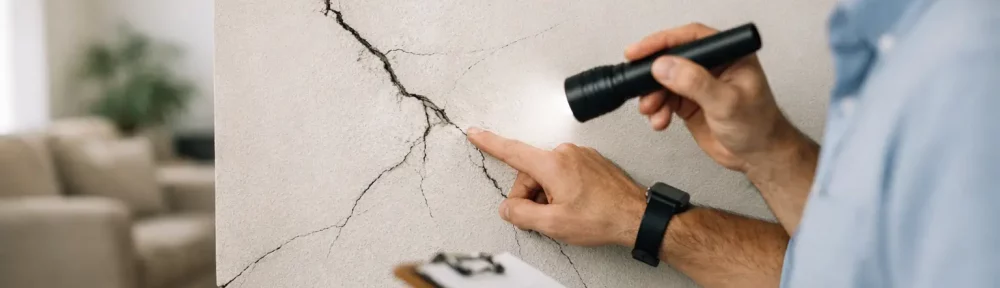
A crack above a doorway, a fine line across fresh plaster, or a stepped split through external brickwork can look alarming. Yet cracks are not all evidence of structural failure. Many are cosmetic, caused by normal drying, minor settlement or changes in temperature and moisture. Knowing how to assess wall cracks means looking beyond the line itself: its position, pattern, width, direction and whether it is changing all matter.
For a buyer, homeowner or landlord, an early and methodical assessment can prevent unnecessary worry while identifying defects that deserve professional investigation. The aim is not to diagnose a building from one crack, but to decide whether it is stable, likely superficial, or a sign of movement that could affect repair costs and safety.
Start by recording what you can see
Do not fill or paint over a crack before you have documented it. Take clear, dated photographs from close range and further back to show its location in the room or elevation. Place a ruler or measuring tape beside it so the width is visible. Note when you first saw it, whether recent building works, leaks, hot weather, nearby tree removal or drainage issues occurred, and whether doors or windows have begun sticking.
A crack’s appearance can change with the light. Examine it in daylight where possible, and check both sides of the wall if accessible. A crack that is visible internally and externally, particularly where it follows a similar route, deserves more attention than an isolated split in internal decoration.
It is also worth checking the wider area. Look for gaps between skirting boards and floors, separation around window frames, distorted brickwork, sagging ceilings, uneven floors and cracks in adjacent rooms. Structural concerns rarely present as a single, neatly contained symptom.
Assess wall cracks by their pattern and location
The width of a crack is useful, but it is not a verdict on its own. A narrow crack can still be significant if it is recent, lengthening or associated with distortion. Conversely, a wider crack in old plaster may be historic and stable. Context is what turns an observation into a sensible risk assessment.
Fine, straight cracks in plaster
Hairline cracks, often under 1 mm wide, commonly occur where plaster dries, paint finishes age or materials expand and contract at slightly different rates. They are particularly common in newly decorated rooms and around plasterboard joints. If they are isolated, fine and unchanged over time, they are usually a maintenance issue rather than a structural one.
Cracks at the junction between a ceiling and wall can also result from minor movement in timber joists, seasonal changes or poor joint detailing. They should still be monitored if they widen or occur alongside sagging, staining or movement in the floor above.
Diagonal cracks around doors and windows
Diagonal cracks running from the corner of a window or door opening are more noteworthy. Openings create weak points in a wall, so movement in foundations, lintels or surrounding masonry often concentrates there. On a rendered wall, the route may be less clear, but cracking that starts at an opening and travels diagonally should not be dismissed simply because the finish looks superficial.
Check whether the crack is wider at one end, whether it continues through brickwork outside, and whether the window or door frame has pulled away from the wall. Difficulty opening or closing the joinery can add weight to the concern, although swollen timber in damp weather can also cause sticking without structural movement.
Stepped cracks in brickwork
A stepped crack that follows mortar joints in a zig-zag pattern is a common sign of differential movement in masonry. It may indicate settlement, subsidence, heave, failed or inadequate support, or localised movement around an opening. The cause cannot be confirmed from appearance alone, but stepped cracking should normally be assessed by a suitably qualified building surveyor or structural professional, particularly if it is wider than a fine hairline, appears fresh or is increasing.
Pay close attention to external walls, chimney breasts, extensions and areas where old and new construction meet. An extension can move differently from the original house, especially where foundations, ground conditions or drainage arrangements differ.
Horizontal cracks and bulging walls
Horizontal cracking in masonry is less common and can be more serious, especially where the wall appears bowed, bulged or displaced. It may relate to lateral pressure, corroding wall ties in cavity walls, roof spread, moisture damage or an issue with restraint. Do not assume it is cosmetic if bricks are lifting, mortar joints are opening or the wall face is no longer flat.
Where a wall is visibly unstable, loose masonry is present, or there is a risk of falling material, keep people away from the area and seek urgent professional advice.
Measure change, not just crack width
Movement is often the deciding factor. A crack that has remained unchanged for years may need repair for appearance or weather protection, but it is less likely to indicate an active structural problem. A crack that is getting wider, longer or appearing in several new locations needs a more prompt response.
For minor cracks where there is no immediate safety concern, mark the ends lightly in pencil and photograph them at regular intervals. Record the width at the same points each time. A simple crack-monitoring gauge can provide more consistent readings, but it must be fitted and interpreted sensibly. Seasonal movement can occur in some properties, so short-term change does not always mean progressive failure.
Avoid relying on a single measurement. Monitor over a meaningful period, particularly where the suspected cause may be affected by weather or tree-related ground moisture. If there is rapid change, a survey should take priority over extended monitoring.
Consider the likely cause before planning repairs
Cracks are symptoms. Filling them without addressing the cause can leave you paying for the same decoration twice. Common non-structural causes include thermal movement, drying shrinkage, settlement in newer construction, loose plaster, poor workmanship and vibrations from nearby work.
More significant causes can include foundation movement, leaking drains, damaged gutters or downpipes, defective underground drainage, clay soils, nearby trees, altered loading, inadequate lintels and deterioration in cavity wall ties. Damp can also weaken finishes and contribute to cracking, but staining and cracking together do not automatically prove subsidence.
The age and construction of the property matter. Older solid-wall houses may show historic movement and lime mortar deterioration that require sympathetic repairs. Modern homes can develop shrinkage cracks as materials dry and settle. Properties on clay ground, homes near mature trees, and buildings with extensions or previous structural alterations often need a more detailed review.
When wall cracks need professional investigation
Arrange a professional inspection without delay when cracks are widening, are roughly several millimetres wide, follow a stepped or diagonal route through brickwork, or are accompanied by distortion. The same applies if there are sticking doors and windows, sloping floors, gaps around frames, visible wall bulging, recurring cracking after repair, or evidence of water ingress and drainage defects.
A pre-purchase situation also changes the decision. Even a crack that appears historic can affect the cost and scope of future work, insurance discussions and price negotiations. A qualified surveyor can inspect the whole building, distinguish likely cosmetic defects from movement-related concerns, identify further checks that may be required and set out practical repair priorities.
For complex cases, the investigation may involve checking drainage, roof loads, nearby vegetation, foundations, wall ties or previous alterations. There is a trade-off here: targeted investigations cost more than a visual inspection, but they can prevent an unsupported assumption from becoming an expensive mistake.
Do not make repairs too soon
Once a crack has been assessed as stable and non-structural, appropriate repair may be straightforward. Fine plaster cracks can often be opened slightly, filled with a suitable flexible filler, sanded and redecorated. External cracks may need compatible mortar repair or render work to prevent water penetration.
Do not use a cosmetic repair to conceal active movement. Rigid fillers can crack again where movement continues, and inappropriate cement-rich mortar can damage older masonry by trapping moisture. If brickwork, render or plaster has failed because of damp, drainage or structural movement, that underlying issue should be resolved first.
A clear inspection record and an evidence-led report give you a stronger basis for deciding whether to monitor, repair, investigate further or renegotiate a purchase. HICH LTD provides specialist building inspections focused on identifying defects, explaining urgency and helping property owners make informed repair decisions. The right next step is not to panic at every crack, but to act promptly when the pattern points to movement.