

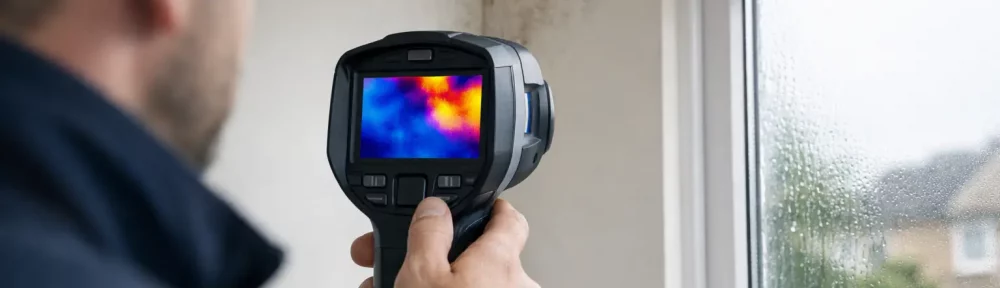
A patch of staining on a bedroom wall rarely tells the full story. By the time paint blisters, plaster softens or mould appears, moisture may already have travelled through masonry, insulation, timber or roof elements. A thermal imaging survey for damp helps trace that movement with far greater precision than a visual check alone, which is why it has become a valuable inspection method for buyers, homeowners, landlords and developers who need clear evidence before spending money on repairs.
What a thermal imaging survey for damp actually does
Thermal imaging detects differences in surface temperature. In buildings, those differences can point to moisture intrusion, evaporative cooling, missing insulation, thermal bridging, hidden leaks or air movement. When damp is present, affected materials often behave differently from dry surrounding areas, creating temperature patterns that a trained surveyor can interpret.
That matters because damp is often misdiagnosed. A cold corner may be labelled rising damp when the real issue is condensation linked to poor ventilation. A stain beneath a flat roof may be treated as an active leak when the defect has already dried and the remaining damage is historic. Equally, a wall that looks dry can still contain concealed moisture. Thermal imaging is useful because it gives a wider picture of how the building is performing, not just how it looks on the day.
The key point is that thermal imaging is an investigative tool, not a shortcut. On its own, a thermal camera does not “see damp” in the simplistic way some marketing suggests. It records heat variation. The value comes from the surveyor’s ability to connect those patterns with building construction, likely moisture sources and supporting inspection evidence.
Why thermal imaging is useful for damp diagnosis
In practical terms, a thermographic survey can reduce guesswork. Instead of opening up large areas unnecessarily, the inspection can narrow down where moisture is likely to be entering or collecting. This is especially helpful in occupied homes, blocks of flats, extensions, loft conversions and recently refurbished properties where disruption needs to be kept under control.
For a buyer, this can mean understanding whether visible damp marks are isolated defects or signs of a broader issue affecting walls, ceilings or concealed timbers. For an owner, it can mean distinguishing between a plumbing leak, roof ingress and condensation-related cold bridging. For landlords and developers, it can provide clearer evidence when planning remedial works, dealing with complaints or assessing workmanship.
There is also a cost benefit. Damp treatment is often expensive when approached in the wrong order. Injecting chemical damp proof courses, replacing plaster or redecorating before the source has been identified usually leads to repeat failure. A proper diagnostic survey helps direct spending towards the actual cause.
Where a thermal imaging survey for damp works best
Thermal imaging is particularly effective when damp is linked to roof leaks, penetrating moisture, plumbing defects, insulation gaps and condensation patterns. It can highlight cooler zones around chimney abutments, valleys, parapets, window reveals and external wall junctions where water ingress or thermal weakness may be occurring.
It is also useful in bathrooms, kitchens and utility spaces where concealed pipework may be leaking behind finishes. In some properties, the issue is not active water entry at all but surface condensation forming on chronically cold elements such as lintels, corners, eaves junctions or poorly insulated cavity closures. Thermal patterns can make those defects easier to recognise and explain.
That said, results depend on conditions. A strong temperature differential between inside and outside often improves clarity. Recent rainfall can help reveal active penetration in some cases, but it can also complicate interpretation if all external surfaces are uniformly cooled. This is why survey timing and building context matter.
What the surveyor is looking for
A competent damp investigation does not start and finish with a camera. The surveyor will usually assess the age and construction of the property, visible defects, occupancy conditions, heating and ventilation arrangements, external exposure and any history of leaks or previous repairs.
Thermal images are then interpreted alongside direct observations and, where appropriate, moisture meter readings and targeted checks. For example, a cool area on a ceiling might indicate trapped moisture, but it could also reflect missing loft insulation. A cold patch near skirting level may be linked to dampness, but it could equally be the result of furniture placement, thermal bridging or air leakage.
This is where building knowledge matters. Good reporting should identify not just where anomalies appear, but what is most likely causing them, how urgent the issue is and what sort of remedial action should be considered next.
Common damp problems thermal imaging can help identify
The most common issue is penetrating damp. Water can enter through defective pointing, cracked render, failed flashings, porous brickwork, damaged roof coverings or poorly sealed openings. Thermal imaging may reveal cooler tracks where moisture is spreading internally beyond the obvious stain.
Condensation is another frequent finding. In many UK homes, especially those with upgraded windows but limited extraction, the problem is not groundwater rising through walls but humid indoor air settling on cold surfaces. Thermal imaging can show recurring cold spots that support a condensation diagnosis and help explain why mould forms in particular corners or behind furnishings.
Leaks from plumbing and heating systems are also a strong use case. Hidden pipework beneath floors, behind boxing or within service voids can create localised moisture patterns before major visible damage appears. Catching that early can prevent more costly repairs.
Roof-related damp is equally important. Moisture entry around roof junctions, chimneys, valleys and flat roof coverings can affect ceilings, insulation and timber elements well before the source is obvious from below. In these cases, thermography is often most effective when combined with a roof survey and a close inspection of coverings and flashings.
The limits of thermal imaging
Thermal imaging is highly useful, but it is not magic. It cannot always confirm the exact moisture content of a material, and it cannot replace invasive investigation where serious concealed defects are suspected. If the building has recently been heavily heated, aired, redecorated or dried artificially, patterns may be less reliable. Reflective surfaces and inconsistent environmental conditions can also affect readings.
There are also cases where damp is too established or too diffuse to produce a simple image pattern. In solid wall properties, listed buildings and structures with multiple historic alterations, interpretation needs extra care. The right approach is to treat thermal imaging as part of a broader diagnostic process rather than a standalone verdict.
For that reason, choosing a qualified surveyor is more important than choosing the most impressive-looking camera. Experience in building pathology, moisture behaviour and construction defects will usually make the difference between a useful report and an expensive set of coloured images.
When to book a survey
If you are seeing recurring staining, mould growth, a persistent musty smell, unexplained cold patches or decoration failure, it is sensible to investigate before carrying out cosmetic repairs. The same applies if you are buying a property with visible damp indicators or have been told there may be moisture issues by an estate agent, contractor or mortgage valuer.
A thermal imaging survey is also worth considering after roof repairs, plumbing leaks or refurbishment work where you want to confirm whether affected areas have properly dried and whether any hidden spread remains. For landlords and developers, it can support planned maintenance and provide documented evidence when assessing complaints or workmanship concerns.
In many cases, speed matters. Moisture-related defects tend to become more expensive the longer they are left, particularly where timber decay, damaged finishes or insulation failure are involved. A prompt inspection gives you a better chance of dealing with the cause before the repair scope expands.
What a good report should give you
A useful report should do more than state that damp exists. It should explain where anomalies were detected, what the likely causes are, whether the issue appears active or historic, and what further action is recommended. That might include repairs to roof details, masonry maintenance, ventilation improvements, plumbing investigation or local opening up.
For clients making financial decisions, this clarity is critical. Buyers need evidence they can use in negotiations. Homeowners need to know whether they are facing a minor maintenance item or a wider defect. Developers and dispute parties need reporting that stands up to scrutiny and points clearly to likely liability, sequencing and repair priorities.
At HICH LTD, this is where specialist inspection matters most. The value is not just in identifying temperature variation, but in turning survey findings into practical, repair-focused advice that helps clients move forward with confidence.
If damp is showing itself in your property, the cheapest option is rarely to guess. The sensible next step is to identify the problem properly, while the evidence is still there and before unnecessary repairs start to build up.